



Why Frontline Roles Are Becoming the Most Strategic Talent Segment in Financial Services | A. Ganesh | CHRO | Shriram Finance Limited
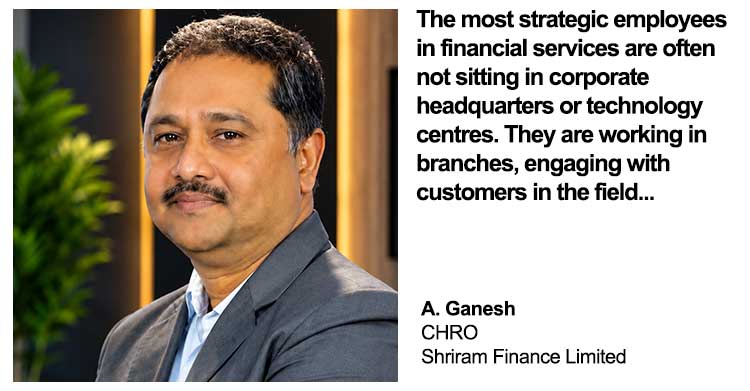 As financial institutions accelerate their digital transformation journeys, an interesting reality is emerging. The most strategic employees in financial services are often not sitting in corporate headquarters or technology centres. They are working in branches, engaging with customers in the field, helping first-time borrowers understand credit, supporting small business owners, and building relationships in markets where trust remains fundamental to every financial decision.
For years, talent discussions in the financial sector have largely centred around leadership pipelines, specialist functions, and corporate roles. While these remain important, the spotlight is increasingly shifting towards frontline employees—the professionals who interact with customers every day and directly influence how financial institutions are experienced.
Across financial services, such as lending, insurance, wealth management, and banking, frontline employees have become the bridge between institutions and customers. In a marketplace where products can be replicated and digital capabilities are becoming standard, the quality of human interaction has emerged as a critical differentiator. As a result, frontline talent is no longer viewed solely as an operational workforce; it is increasingly becoming a strategic business asset.
Frontline Employees Are the New Custodians of Trust
Financial services have always been built on trust. While technology has transformed how services are delivered, customers continue to seek human reassurance when making important financial decisions.
This becomes even more relevant in a country like India, where millions of customers are entering the formal financial system for the first time. For many, the frontline employee represents the institution itself.
As financial inclusion expands and institutions deepen their presence beyond metropolitan markets, customer-facing employees often become the first and most important point of contact between the organisation and the customer. Their role extends beyond selling products. They simplify financial concepts, address concerns, and help customers make informed decisions.
This growing importance is also reflected in hiring trends. According to an Adecco India report, nearly 48% of new BFSI roles now originate from Tier-II and Tier-III cities, reflecting the growing demand for frontline talent as financial institutions deepen their presence in emerging markets.
From Transaction Processors to Trusted Advisors
One of the most significant transformations taking place in financial services is the evolution of frontline roles themselves.
Historically, many frontline functions were largely transactional. Employees focused on documentation, application processing, collections, and routine customer service. Today, technology has automated much of this work.
As digital platforms take over repetitive processes, customer expectations are changing. Customers increasingly seek guidance rather than transactions. They want help understanding products, evaluating options, and navigating financial decisions with confidence.
This shift is transforming frontline employees from process facilitators into trusted advisors.
Whether it is helping a customer choose an appropriate financing solution, explaining repayment options, supporting a first-time borrower through the credit journey, or guiding a small business owner understand funding opportunities, frontline professionals are increasingly expected to combine financial knowledge with relationship-building skills.
The role today demands far more than operational efficiency. It requires communication skills, business understanding, digital literacy, empathy, and sound judgement.
The Rise of the Hybrid Frontline Professional
There is a common perception that advances in artificial intelligence, automation, and digital banking will reduce the importance of customer-facing roles. The reality is proving to be rather ta different.
Technology is changing the nature of frontline work rather than diminishing its value.
Automation is reducing administrative workloads and enabling employees to focus on higher-value activities. AI-powered tools are helping teams understand customer preferences, identify opportunities, prioritise leads, and deliver more personalised experiences.
As routine tasks become increasingly automated, distinctly human capabilities such as judgement, relationship-building, problem-solving, and emotional intelligence become even more valuable.
The frontline professional of the future will operate at the intersection of technology and relationships. They will use digital onboarding platforms, AI-powered insights, analytics tools, and automated workflows while continuing to perform the fundamentally human tasks of understanding customer needs and providing guidance.
Frontline Talent Is Becoming Harder to Build
The growing strategic importance of frontline employees comes at a time when the industry is facing increasing talent challenges.
Rising attrition, changing workforce expectations, and rapid business expansion are making it more difficult to attract and retain customer-facing talent. Industry studies indicate that frontline attrition remains significantly higher than many other workforce categories across financial services, creating challenges for continuity, customer experience, and operational efficiency.
At the same time, the role itself is becoming more complex. Frontline employees are expected to balance customer engagement, regulatory compliance, digital adoption, business development, and service delivery, all while operating in a rapidly evolving environment.
This makes workforce development a business priority rather than an HR initiative. Organisations can no longer view frontline roles as positions that can be easily replaced. They are increasingly becoming long-term talent investments that directly influence customer outcomes and business performance.
Building the Frontline Workforce of the Future
As frontline roles continue to evolve, organisations must rethink how they identify, develop, and retain talent.
The frontline professional of tomorrow will require a broader set of capabilities than ever before. Financial knowledge remains essential, but it must be complemented by digital fluency, analytical thinking, adaptability, communication skills, and customer-centricity.
Employees will need to navigate digital tools confidently while simultaneously delivering personalised customer experiences. The ability to interpret customer needs, provide consultative guidance, and build lasting relationships will become increasingly valuable.
Continuous learning is therefore no longer optional—it is essential.
The pace of technological change means workforce development must become an ongoing process rather than an occasional intervention. Employees need opportunities to acquire new skills, adopt emerging technologies, and adapt to evolving customer expectations.
For frontline employees, learning can no longer be confined to classrooms or periodic workshops. Capability-building must become continuous, accessible, and embedded within the flow of work through digital learning platforms, mobile-first content, real-time coaching, and practical on-the-job development.
The urgency of workforce transformation is already visible across industries. According to the NIIT India Skills Gap Report 2026, 69% of organisations increased their learning and development budgets in the past year, driven largely by digital transformation and business growth priorities. The finding reflects a broader shift in mindset. Learning and capability-building are no longer support functions; they have become strategic business priorities.
Reimagining the Frontline Employee Experience
If frontline employees are becoming the most strategic talent segment, organisations must also rethink how they support and engage them.
Many employee experience initiatives have historically been designed around corporate office environments. Frontline employees, however, operate under very different conditions. Their work involves customer interactions, field responsibilities, performance targets, and constantly changing operational realities.
Creating a strong frontline work enviroment requires a more tailored approach.
Organisations need to equip employees with the right technology, provide access to real-time information, simplify processes, enable mobile-first learning, and create clear career pathways for growth. Recognition, leadership visibility, and opportunities for advancement are equally important in strengthening engagement.
When frontline employees feel empowered and supported, they are better positioned to deliver superior customer experiences. In many ways, employee experience and customer experience are becoming inseparable.
Looking Ahead
The future of financial services will be shaped by a combination of technological innovation and human capability.
While organisations will continue investing heavily in digital transformation, the most successful institutions will be those that place equal emphasis on talent transformation.
Frontline employees occupy a unique position within this equation. They connect strategy with execution and technology with customer experience. As financial institutions expand into new markets, serve increasingly diverse customer segments, and embrace emerging technologies, their role will become even more central to organisational success.
For HR leaders and business leaders alike, the message is clear: frontline talent is no longer simply a workforce category. It is a critical driver of customer confidence, business growth, and long-term competitive advantage.
As the industry evolves, one truth is becoming increasingly evident: the future of financial services will be shaped not just by the technologies organisations adopt, but by the people who bring those technologies to life for customers every day.