



Why Senior Hiring Fails Before the Interview Begins | Taru Shikha | Founder & CEO | HiredNext Recruitment
Senior hiring is often discussed as if the decisive moment happens in the interview room.
In practice, many senior searches begin going wrong much earlier.
They fail when the organisation has not clearly defined the problem it wants the new leader to solve. They fail when a job description becomes a collection of responsibilities rather than a statement of business outcomes. They fail when strong candidates are rejected because their CV does not mirror the exact language used internally. And they fail when everybody involved in the process has a slightly different definition of the person they are trying to hire.
By the time interviews begin, many of these problems are already embedded in the process.
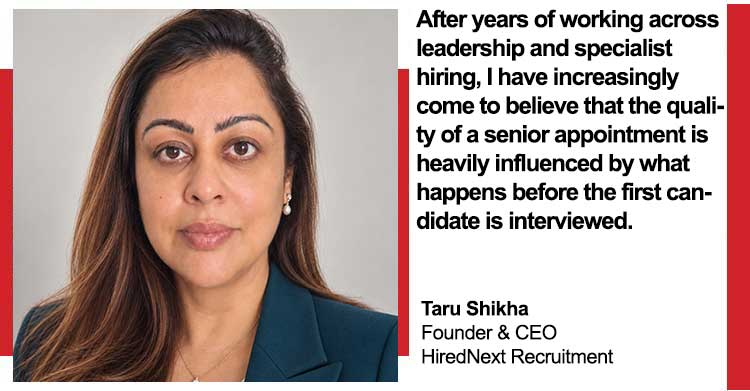
After years of working across leadership and specialist hiring, I have increasingly come to believe that the quality of a senior appointment is heavily influenced by what happens before the first candidate is interviewed.
A job description is not the same as a hiring brief
One of the first difficulties in senior hiring is that organisations often begin with a job description.
A job description tells us what a person may be responsible for.
A good hiring brief answers a much more important question:
Why does this organisation need this person now?
Consider two companies hiring a CFO.
One may need a finance leader to strengthen controls and reporting.
Another may be preparing for institutional funding, an IPO, acquisitions or international expansion.
A third may have a capable finance team but require someone who can become a strategic partner to the promoter or CEO.
The designation may be identical.
The candidate required for each situation may be completely different.
The same applies to technology, HR, manufacturing, operations and other leadership functions. A CTO hired to stabilise an existing technology organisation is not necessarily the same CTO required to build a technology function from the ground up.
Until the business problem is clear, the search cannot truly be clear.
Senior candidates rarely fit perfectly into keywords
The second problem is excessive dependence on titles and keywords.
At junior and mid-management levels, keyword matching can be useful. At leadership level, it can become misleading.
A senior professional may have spent five years transforming a business without ever having the word “transformation” in the job title.
Someone may effectively have been running a business unit while carrying a functional designation.
Another executive may have built teams, integrated acquisitions, opened markets or redesigned operating models yet their CV may describe much of this as routine responsibility.
This creates an uncomfortable reality in recruitment:
Sometimes the candidate is stronger than the document representing the candidate.
A hiring process that reads only the CV literally can therefore eliminate precisely the kind of person it is trying to find.
This does not mean overlooking evidence. Quite the opposite.
It means understanding the evidence behind the words.
What changed because this person was there?
What scale did they operate at?
What decisions did they own?
What was broken when they arrived?
What was stronger when they left?
Those questions reveal considerably more than a list of responsibilities.
Alignment inside the company matters more than people realise
Another frequent problem appears when several stakeholders participate in senior hiring.
The CEO wants one thing.
The functional leader wants another.
HR has been given a different brief.
The interview panel adds further requirements after meeting the first few candidates.
The search then begins to move.
Candidates who were initially considered strong suddenly become unsuitable because the specification itself is changing.
This is expensive.
Not only in recruiter time or interview hours, but in the credibility of the organisation in the talent market.
Senior candidates are also assessing the company.
When three interviewers describe three different versions of a role, experienced candidates notice.
Before beginning a leadership search, organisations should therefore align on a relatively small number of non-negotiables.
What must this person achieve in the first 12–18 months?
Which capabilities are essential?
Which experiences are preferred but teachable?
What kind of organisation has this person successfully operated in before?
And just as importantly: what are we willing to compromise on?
Perfect candidates rarely exist.
Clear trade-offs do.
Search should begin with the market, not end with it
There is also a tendency to create a specification internally and only later discover whether the market contains enough people who match it.
For difficult senior searches, market intelligence should enter much earlier.
If an organisation wants a very specific combination of sector exposure, scale, geography, functional depth, compensation and leadership experience, it is useful to understand how many such people realistically exist.
Sometimes the answer is hundreds.
Sometimes it is thirty.
Sometimes it is five.
That information should influence the search strategy.
It may mean widening the industry pool.
It may mean reconsidering compensation.
It may mean separating what is genuinely essential from what simply feels desirable.
The best searches become conversations between business need and talent-market reality.
AI will improve senior hiring but judgement remains critical
AI is already changing how organisations source, screen and analyse talent.
It can process large volumes of information, identify patterns, improve research and reduce administrative work.
That is valuable.
But senior hiring contains elements that are difficult to reduce to matching.
Ambition.
Judgement.
Leadership maturity.
Context.
The ability to influence.
The difference between someone who maintained a successful operation and someone who actually created it.
AI can help us ask better questions.
It should not stop us from asking them.
The strongest hiring models, in my view, will be AI-assisted but human-led, particularly where the cost of a wrong appointment is high.
The interview should confirm a hypothesis, not begin the investigation
By the time a senior candidate enters the formal interview process, the organisation should already understand why that person may fit.
The interview should explore that hypothesis more deeply.
It should not be the first moment when somebody asks whether the candidate has actually dealt with the business problem at hand.
That work belongs earlier.
A thoughtful senior search therefore starts with diagnosis, moves into market mapping and evidence-based assessment, and only then progresses to interviews.
When that groundwork is done properly, interviews become sharper, candidate experience improves and decision-making becomes considerably clearer.
The most expensive hiring mistakes are not always caused by poor interviews.
Sometimes the real mistake happened weeks earlier when the organisation started searching before it had decided exactly what it was searching for.