


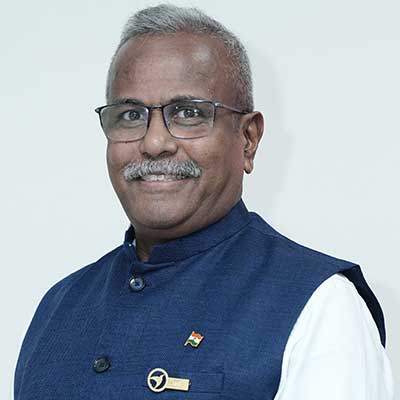
The Enterprise Is Hiring a New Kind of Employee | Prasad Rajappan | Founder and MD | ZingHR
 Workforce planning is moving beyond headcount to outcomes. As AI agents become part of the workforce, organisations will need to plan around KPIs, competencies and business outcomes, determining what to Build, Buy, Borrow and Bot. This brings workforce planning, AOP and budgeting into a single strategic framework, aligning workforce capacity, capability and cost with the outcomes the business needs to deliver.
Across industries, organizations are beginning to introduce AI agents into everyday work – not as another software application, but as active participants in business processes. They analyze information, complete tasks, coordinate workflows, and increasingly support decisions that once depended entirely on human effort.
The most important workforce conversation over the next decade, therefore, will not be whether AI replaces jobs. It will be how organizations integrate a new kind of teammate into the enterprise.
Hiring an AI agent is different from buying software
Most enterprise technology has traditionally been passive. An ERP system records financial transactions. A CRM platform tracks customer engagements. HR systems automate employee processes.
AI agents represent a different category altogether.
Unlike conventional software, they don’t simply wait for commands. They can interpret goals, execute multi-step tasks, interact with multiple systems, and adapt their responses based on changing inputs. In many cases, they become contributors to work rather than tools used to perform it.
This changes the responsibility of leadership.
Introducing AI agents into the workplace is less like installing software and more like onboarding a new employee. Organizations need to define responsibilities, establish guardrails, create oversight, and determine how humans and AI will collaborate to achieve shared outcomes.
The technology may be new, but the leadership principles are surprisingly familiar.
The best organizations will redesign work – not just automate it
The real opportunity isn’t substituting human effort. It’s rethinking how work is divided.
The International Labour Organization’s 2026 report, Changing Landscape of Skills in the Age of AI, highlights how AI adoption is reshaping the skills required across workplaces. While demand for digital and AI capabilities is rising, the report also points to the growing importance of higher-order cognitive and socioemotional skills, alongside adaptability, resilience and human agency. The message is clear: as technology takes on more tasks, the ability to think critically, adapt to change and work effectively with others will become increasingly important.
That shift tells us something important.
As AI agents assume routine analysis and execution, human work becomes more valuable where judgment, context, empathy, and innovation are required. The question is no longer ‘What tasks can AI perform?’ but ‘What work should remain uniquely human?’
This is where many organizations risk focusing on technology instead of design.
Deploying AI agents without redesigning workflows is unlikely to realize their full value. Leaders must rethink how teams operate, how decisions are made and how responsibilities are shared between people and intelligent systems.
The manager’s role is changing too
Every transformation of work has redefined leadership. Managing a hybrid workforce means leading people whose teammates may not all be human.
Managers will increasingly spend less time supervising routine execution and more time exercising judgment, coaching employees, validating AI-generated recommendations, and making decisions where context matters most.
The PwC 29th Global CEO Survey 2026 highlights how AI is moving from experimentation to a broader business transformation imperative. With 42% of CEOs identifying the need to transform fast enough to keep pace with technological change, including AI, as their biggest concern, the focus is shifting from simply adopting new technologies to embedding them across the enterprise. Yet, technology alone will not determine success. Competitive advantage will depend on how effectively organisations integrate AI into their operations, decision-making and, ultimately, the way their people work.
The conversation, therefore, extends far beyond technology. It is primarily about organizational design.
Preparing for a workforce that includes both people and AI
Every organization has spent decades learning how to recruit, develop, and lead people. The next chapter is about learning how people and AI agents can work together effectively.
This isn’t a future where AI replaces employees, nor one where humans supervise machines. It’s a future where success depends on designing teams that combine the speed and scale of AI with the judgment, creativity and empathy of people.
For HR, this signifies an important shift. Its role is no longer confined to managing the employee lifecycle; it increasingly becomes the function that helps organizations understand how work is created, how teams evolve, and how human and digital talent contribute to business outcomes.
That requires a new way of thinking. AI agents cannot operate in isolation from people, just as workforce decisions cannot exist in isolation from business priorities. Organizations will need a connected view of both, one that brings together workforce intelligence and business intelligence to help leaders make faster, more informed enterprise decisions.
The enterprises that succeed will not be those with the highest number of AI agents. Still, those that create an environment where people and intelligent systems complement one another, learn from one another, and jointly drive business performance will succeed. In that future, HR won’t simply support the business – it will help shape how the business thinks, adapts, and grows.