



From jobs to skills: How AI is rewiring workforce architecture | Abhishek Agarwal | President | Judge India & Global Delivery | The Judge Group- a leading IT solutions company
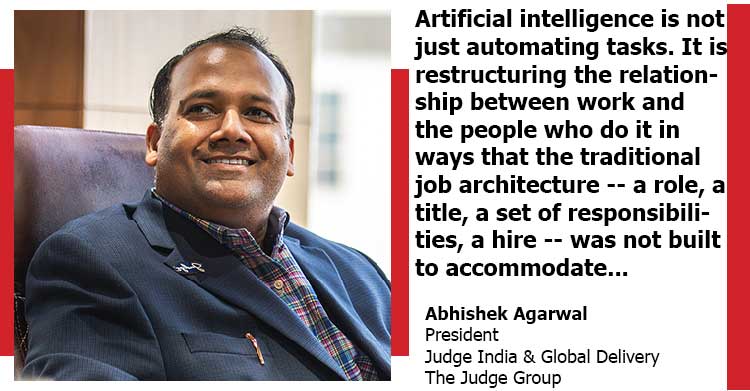
The job description is becoming obsolete. Not immediately, and not everywhere — but the trajectory is clear enough that organisations still building workforce strategies around fixed role definitions are designing for a reality that is already changing underneath them. Artificial intelligence is not just automating tasks. It is restructuring the relationship between work and the people who do it in ways that the traditional job architecture — a role, a title, a set of responsibilities, a hire — was not built to accommodate.
The shift from jobs to skills as the organising unit of workforce planning is not new as a concept. It has been discussed in HR and talent management circles for years. What AI has done is make it urgent. When a generative AI system can produce a first draft, analyse a dataset, summarise a meeting, generate code or answer a customer query — all tasks that were previously stable components of defined roles the question of what a human worker is being hired to do becomes considerably more dynamic. The answer changes as the tools change, which means the workforce architecture needs to change with it.
Skills-based organisations are built differently. Rather than structuring talent around a hierarchy of jobs, they map work to capability clusters — what needs to be done, what skills it requires, who has those skills or can develop them, and allocate human attention accordingly. This enables internal mobility at a speed that traditional job-based structures cannot match. A data analyst with strong communication skills and domain knowledge of financial services can contribute to a product strategy conversation in ways that a job description would never have surfaced them for. The skills model makes that visible and actionable.
For technology and staffing organisations operating at the intersection of talent and AI transformation, this shift has immediate practical implications. The most valuable talent is no longer the person who best executes a defined set of tasks. It is the person who can navigate ambiguity, work effectively alongside AI tools, apply judgment where automation cannot, and continuously extend their capability into adjacent domains as the technological environment evolves. Identifying, developing and deploying that kind of talent requires a different set of practices than traditional recruitment and performance management.
The global managed services model is evolving to reflect this. Clients are increasingly asking not just for people who can fill a role, but for capabilities that can be assembled around specific business outcomes and reconfigured as those outcomes evolve. The engagement model shifts from staffing to capability partnership. The value delivered is not headcount — it is the right skills, at the right time, organised to produce measurable impact on a problem the client is actually trying to solve.
Organisations that move first on this — building skills taxonomies, investing in continuous learning infrastructure, creating internal talent marketplaces, and measuring workforce health in terms of capability breadth rather than headcount stability will find that AI amplifies their people rather than replacing them. The transition from a job-based to a skills-based architecture is not painless and not quick. But it is the direction that a workforce in an AI-augmented world is pointing in. The organisations that read that direction early will have a material advantage over those that wait until the old model has fully broken down before beginning the redesign.