



Happiness at Work Is Not a Gesture. It Is a Signal the Market Is Still Learning to Read | Raj Nayak | Founder | House of Cheer and Happiest Places to Work®️
There is a quiet truth most people recognise but rarely articulate. Happiness does not come from what happens occasionally. It comes from what is consistently experienced. This holds as much in life as it does at work. Organisations, in their own way, have always tried to create those moments. Offsites, shared experiences, celebrations, gestures. They matter. They bring people together. They create memories. But their real value is not in the moment itself, it is in what they signal. Because what people carry back is not the event, but the feeling. And that feeling is shaped far more by what happens every day than by what happens once in a while.
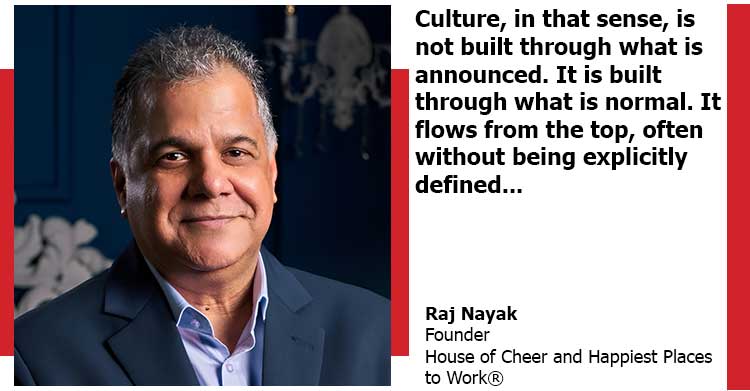
Culture, in that sense, is not built through what is announced. It is built through what is normal. It flows from the top, often without being explicitly defined. People observe how leaders respond when someone disagrees, when a decision is questioned, when something does not go as planned. These are not big moments, but they are revealing ones. Over time, they set the tone. And that tone is easy to recognise. You can walk into any organisation and sense it. The energy. The ease of conversation. Whether people feel a sense of belonging. Whether they are speaking freely or choosing their words carefully. Whether ideas are being explored or quietly held back. That feeling does not need measurement. It is experienced.
Years ago, Tata Steel ran a campaign with a simple line: “Dissent is the voice of progress.” It reflected a belief that many organisations hold in spirit. That different views are not a disruption, but a way to move forward. That people should feel the freedom to speak, even when it challenges the norm. Where that belief is lived, not just stated, something shifts. People participate more fully. They take decisions with a sense of autonomy. They engage not because they are required to, but because they feel part of what is being built. And that kind of environment has a certain stability to it. It does not depend on constant stimulation. It sustains itself.
There is a broader parallel that is easy to relate to. Between late December and early January, there is a noticeable change in how people behave. There is a lightness. A sense of openness. People are more generous with their time and attention. Even in a country like India, you can feel it. This is not by chance. Over many years, this period has been associated with celebration, giving, and togetherness. The idea has been repeated and reinforced across generations, across mediums, across experiences. Over time, it has become instinctive. This is what seeding happiness looks like. Not creating it once, but nurturing it until it becomes part of how people experience something.
In organisations, the same principle applies. Happiness is rarely the result of a single initiative. It is the outcome of many small, consistent experiences. How people are treated on a regular day. Whether they feel heard. Whether they experience autonomy in their roles. Whether they feel a sense of belonging. Whether they feel they have the freedom to speak, decide, and still belong. These are not always visible. But they are felt. And increasingly, they are also being understood as indicators of something larger.
There is growing evidence that organisations where people report stronger levels of trust and ease tend to perform better over time. This includes not just operational consistency, but also long-term market performance. Not because they are doing something dramatically different, but because they are functioning with greater clarity. Decisions move with less friction. People stay longer. There is continuity in thinking and execution. In simple terms, the system works more smoothly. What is interesting is that this connection is now being looked at more closely. Financial metrics tell us what has already happened. Culture offers a sense of what is likely to happen. But because culture has traditionally been harder to quantify, it has often been treated as secondary. That is beginning to change.
There is a growing effort to understand employee experience in a more structured way. Not just through participation scores or one-time feedback, but by looking at patterns. By asking not just what is offered, but what is actually experienced. Frameworks like Happiest Places to Work are part of this shift. Over time, they are beginning to emerge as a more credible reference point for organisations that want to understand and benchmark how people truly experience their workplace. Not as a badge, but as a reflection. A number of organisations across sectors have started engaging with such frameworks, not for recognition, but for insight. More recently, even institutions that have long shaped the thinking around people practices, such as SHRM India, have chosen to come into the fold. That, in itself, signals a certain level of seriousness around how workplace experience is being understood and measured. In many ways, this is how standards evolve. Quietly at first, and then with wider acceptance. What was once seen as an internal metric begins to find external credibility. And over time, it starts to resemble a gold standard, not by declaration, but by adoption.
Because in the end, happiness is not something that can be declared. It is something that is sensed. Which is why the idea itself needs a simple reframing. Happiness is not something organisations create from time to time. It is something they enable, often without drawing attention to it. And over time, that quiet consistency tends to show up in ways that go beyond culture. It reflects in how people show up, how decisions are made, and how organisations perform. Even if the market is still learning how to fully read that signal.