



The CHRO’s Role in Building a Business-First, People-Driven Organisation | Sachin Mathur | HR Head | Ideaforge Technology Ltd
The HR function has evolved more in the past decade than it did in the two before it. What once revolved around policies, payroll cycles, and compliance now sits at the centre of conversations on growth, capability/capacity, and organisational design. With Digitalisation reshaping roles every quarter, teams operating across geographies, employee expectations around work becoming more nuanced, and regulations shifting constantly, the CHRO’s job has expanded quietly but significantly.
The role is far less about guarding processes and far more about understanding how people, structure, and capability influence the direction a business can realistically take.
HR as a Strategic Driver of Business Decisions
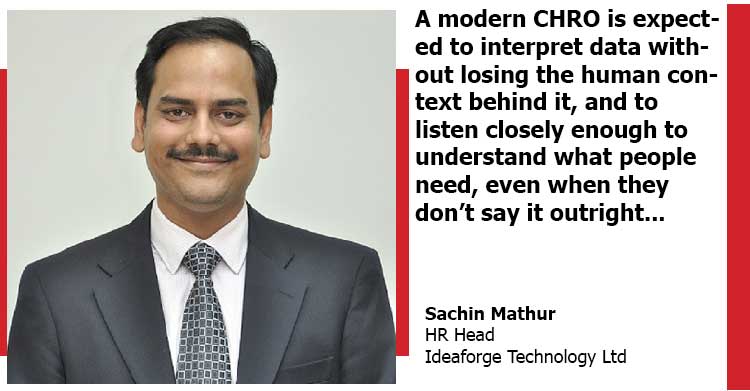
With that shift comes a different kind of responsibility. A modern CHRO is expected to interpret data without losing the human context behind it, and to listen closely enough to understand what people need, even when they don’t say it outright. This mix of insight and analysis is what CEOs and CFOs now lean on. Decisions about expansion, new products, or even how teams should be organised often depend on whether the talent, culture, and energy of the organisation can support those ambitions. This is why the CHRO now sits closer to the strategic table, not through a change in title, but through a change in what the business requires to grow responsibly.
What becomes interesting is how HR translates these expectations into action. The CHRO becomes the one who asks, “Can our people carry this plan forward? And if not, what must shift?” It’s a quieter but more influential kind of leadership that places HR at the centre of long-term organisational resilience.
Navigating a Rapidly Evolving People Landscape
Workplaces today move in ways that are harder to predict. Teams want flexibility, meaningful work, and growth, and they want these things to hold steady even when everything else shifts. At the same time, organisations are trying to make sense of hybrid routines, new technologies, and a regulatory environment that keeps changing. None of it follows a straight line.
For a CHRO, the job is less about reacting and more about reading what’s coming. In fast-moving tech environments, that often means paying closer attention to how skills evolve; a gap in data or cybersecurity talent, for instance, can slow down entire projects before anyone realizes what happened.
Most of us have seen how quickly engagement or retention can tilt performance. When people feel supported, problems get solved faster, and teams hold together better. When they don’t, the drop in energy is immediate. That’s why decisions around workforce planning, culture, and capability can’t sit on the sidelines anymore; they shape how well the business can move, quarter after quarter.
Turning People Strategy into Business Outcomes
It’s not enough today to launch new initiatives and hope they create impact. Leaders want to see whether these initiatives actually moved the needle. Did a leadership program improve decision-making? Did an inclusion effort reduce attrition? Did a new way of working help people produce better results?
CHROs now have to connect the dots clearly. When a development
program strengthens collaboration between functions, it should reflect in project outcomes. When an improved work environment lowers absenteeism, it should be visible in productivity. These linkages make HR’s contribution visible without overstating it, and the results speak for themselves. Moreover, this helps leaders see HR not as an expense line but as an investment that pays off in measurable ways.
Embedding People-First Systems That Actually Work
Most organisations have good intentions; the challenge is turning those intentions into everyday practices people can actually feel. The HR teams that do this well usually notice the small shifts first: a dip in energy, slower decisions, or conversations that don’t sound like they used to. These early signs often matter more than any formal report.
The solutions don’t have to be big. Sometimes it’s trying a different schedule with one group, adjusting how teams share feedback, or testing a new tool with a small set of employees before rolling it out. These small trials reveal what genuinely helps.
When the employee experience is consistent, from hiring to growth and even exit, people know what the organisation stands for. That stability builds trust. And once trust is in place, teams work with more clarity and far less friction.
Aligning Purpose With Performance
Most people today want to feel that their work matters. The CHRO plays a big part in helping teams see how their daily responsibilities connect to the organisation’s broader mission. When people understand the ‘why’,
performance systems make more sense, recognition carries more meaning, and promotions feel fairer.
Purpose becomes tangible when it shows up in everyday decisions, not just in townhalls or documents, but in how goals are shaped, how leaders communicate, and how teams acknowledge progress. When this alignment is done well, employees feel ownership, and with that comes motivation that doesn’t need constant pushing.
Building Leadership That Can Handle Change
Leadership roles have changed, and older models don’t hold up anymore. Instead, leadership development has become a continuous, hands-on process. Coaching, exposure to new environments, and cross-functional projects – these experiences shape leaders far more effectively. A strong leadership pipeline is one of the most reliable predictors of organisational stability, especially in times of rapid change.
A CHRO must watch this pipeline closely because strong leaders create strong teams, and strong teams hold the organisation together.
Measuring Impact and Accountability
Every people initiative today is expected to show outcomes. Culture programs, learning investments, and well-being support all of these need metrics that show how they influenced performance, retention, engagement, or stability. Transparent dashboards help leaders track what’s working and what needs course correction. Evidence-based decisions also ensure that HR strategies remain strong even in uncertain periods.
This discipline around measurement builds credibility, not only for HR, but for the organisation’s overall approach to its people.
The CHRO as Strategic Architect
The modern CHRO is no longer defined by process management alone. The role has expanded into one that shapes culture, builds capability, anticipates workforce shifts, and ensures that people and business priorities move together. The strength of the role lies in balancing empathy with clarity, understanding what employees need while keeping sight of what the organisation must deliver.
Companies that truly put people at the centre of their decisions tend to outperform expectations. Not because of slogans, but because they treat “people-first” as a discipline, one that can be measured, repeated, and improved. The CHRO is central to making that discipline real. As organisations continue navigating change, the HR function becomes not just a support system, but one of the most strategic levers of long-term success.