



Scaling with Culture: Balancing Growth and Empathy HR’s Role in Hospital Integration and People-First Expansion | Karuna Ponnada | Group CHRO | ASG Eye Hospital
Hospitals are in a race to grow. They are scaling faster than ever to get close to their patients through greenfield rollouts and brownfield affiliations and acquisitions. While integration of processes and protocols, safety practices and norms are important, it is also necessary to focus on cultural alignment. After all, it is organisational culture that affects the success of post-merger integration. And this is where the Chief Human Resources Officer (CHRO) plays a crucial role.
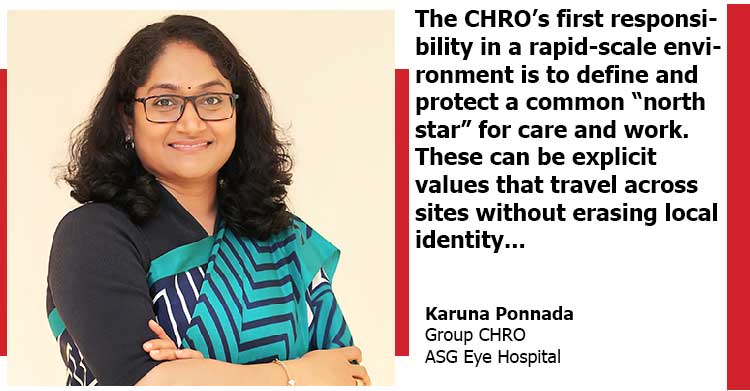
The CHRO’s first responsibility in a rapid-scale environment is to define and protect a common “north star” for care and work. These can be explicit values that travel across sites without erasing local identity. Practically, this must begin before Day 1 of integration with a structured cultural assessment, followed by an extended plan well in advance that evaluates policies and ensures harmonization across different stakeholders, with relationship-building. It becomes essential to clearly define leadership behaviours that reflect the evolving culture and ensure they are embraced consistently across the organisation. Non-negotiables like hospital safety expectations, culture
language, credentialing pathways, and safeguarding protocols must be standardised, while allowing leaders meaningful autonomy. People metrics must be tracked alongside operational KPIs.
Empathy cannot remain a slogan at town halls; it must be built into daily work. While U.S. studies show physician burnout dipping below 50%, India faces equally urgent challenges: chronic workforce shortages, uneven urban–rural staffing, heavy patient loads, and a talent pipeline struggling to meet demand. Scaling healthcare without addressing these issues is building on a weak foundation. Indian CHROs must focus on protected breaks, predictable rosters, rapid mental-health access, safe escalation pathways, and targeted upskilling, especially in Tier 2/3 cities. When empathy is embedded in operations, caregivers stay resilient and patients receive safer, more compassionate care.
Psychological safety is essential to a healthy culture. When teams feel comfortable speaking up about near misses, problems in the workflow, or workload pressures, they’re able to deliver safer care. Research shows that psychological safety is directly linked to better patient-safety outcomes and creating that environment is a key responsibility of the CHRO. This means making sure leaders get the right management training, incident reviews are handled fairly, and recognition systems highlight learning and improvement rather than blame.
A happy employee delivers a happy customer experience. In healthcare, large-scale engagement data consistently shows that when workforce engagement rises, patient experience and safety culture rise with it. A unified “pulse-to-patient” dashboard tracking safety, vacancy and time-to-fill, alongside patient-experience and incident-learning indicators helps CHROs spot where employee and patient trends diverge and target interventions such as manager coaching, refreshed recognition, and peer-to-peer learning. The north star is simple: technology and processes must de-stress, not dehumanize work, because the happiest teams deliver the safest, most compassionate care.
Retention must be a core strategy. Replacing talent is costly and the cumulative financial loss could have funded growth, technology, or staff development. Integration must also take into account fair pay across units and internal growth pathways. The aim must be to bond new talent to the culture within weeks. Cultural immersion sessions, structured buddy support, and early visibility of leadership help new team members integrate smoothly and understand the organisation’s way of working from the start.
Finally, culture scales through leaders. As we open or integrate hospitals and units, we must over-invest in manager readiness. Growth must become the outcome of empathy at scale, where people feel safe, heard, and supported; and patients feel seen; even as the business keeps expanding. That is the CHRO’s mandate in hospital integration, to build systems that make empathy operational, and culture will do the compounding.