



Leading your Workforce through Change with AI | Meredith Graham | Chief People Officer | Ensono
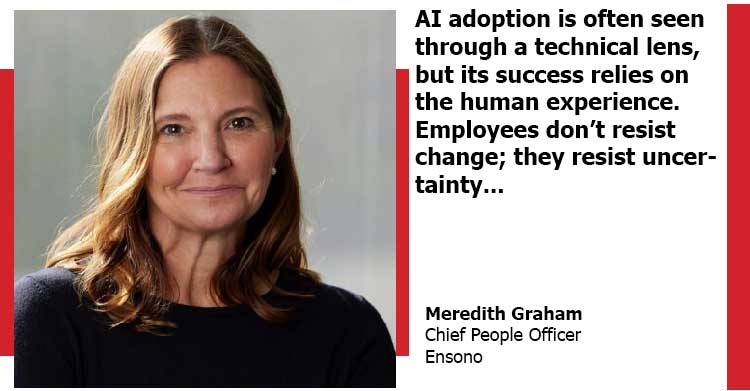
“Technology evolves every day, but what remains constant, and at the heart of every transformation are the people. As workplaces embrace AI, our foremost responsibility is to ensure every employee is equipped to leverage these tools confidently, and feels supported, valued, and empowered throughout the journey. Human progress is not just about innovation; it’s about inclusion.”
The rise of Artificial Intelligence (AI) has created a defining moment for leadership. Across industries, conversations are shifting from what AI can do to how it will reshape people, purpose, and progress. It’s easy to be captivated by technology’s promise in terms of faster processes, smarter decisions, and sharper insights. Yet, beneath every algorithm lies something even more powerful: the human potential that enables it.
AI may transform the way we work, but it is leaders who determine whether that transformation feels empowering or unsettling. The question isn’t whether AI will change work, the shift is already taking place. The real question is how we lead our people through this change.
AI adoption is often seen through a technical lens, but its success relies on the human experience. Employees don’t resist change; they resist uncertainty. The real challenge isn’t integrating tools, its inspiring trust and confidence in them to infuse AI in their daily tasks. When people understand how AI complements their work rather than threatens it, engagement rises. Studies show that organisations that prioritise retention through empowerment giving employees’ meaningful roles in transformation are believed to gain measurable growth in loyalty and performance as indicators. When AI is positioned as a partner, not a replacement, employees feel included and valued in shaping the future rather than reacting to it. The organisations that thrive in the age of AI will be those that invest not just in technology, but in mindset. Leaders must ensure individuals know and believe in “You belong in this future.”
Leading with AI requires a fundamental mindset shift, from managing systems to coaching humans through ambiguity. The role of the leader is evolving from being an advocate of technology to being a steward of human adaptability. Transparency becomes the new trust currency. People want to know what AI will change, but more importantly, what it will not replace i.e. creativity, empathy, critical thinking. Great leaders explain the ‘why’ behind the change, invite teams to co-create new workflows, and normalise learning as a shared journey. When leaders show vulnerability by acknowledging that they, too, are learning, they foster psychological safety to its employees. It’s this environment of shared growth that builds resilience in the face of disruption.
Trust grows when organisations are transparent about how AI works, where human judgment fits, and how decisions are validated. Inclusion strengthens when leaders ensure everyone has equal access to AI skills and opportunities. A culture that values ethics, diversity, and open dialogue will turn technology into a force for empowerment, not exclusion.
Vision without action achieves little. Leading AI transformation means taking human-centered steps: demystify AI, communicate its purpose and limits, and prioritise continuous learning. Success should be measured not just by productivity but by confidence, adoption, and inclusivity. Above all, leaders must keep a human lens on every decision—ensuring fairness, responsibility, and transparency. Recognizing effort, listening deeply, and making people feel valued will define progress.
The future isn’t man or machine, but about both, working together. As AI handles repetitive tasks, people will have more space to focus on creativity, empathy, and complex problem-solving, qualities that technology can’t replace. The workplace of the future will blend digital efficiency with human insight, driven by data and guided by purpose. To lead effectively, organisations must foster curiosity, inclusion, and trust. The future of work won’t be defined by technology alone, but by how courageously we lead people through it. Leaders who anchor AI in empathy and clarity will create workplaces that are not just efficient—but deeply human.
“As a leader, our role isn’t just to adopt AI, it’s to anchor it in humanity. The leaders who infuse clarity, empathy, and trust into this transformation won’t just manage change; they’ll shape the future of work. Humanizing AI isn’t a soft skill; it’s a strategic imperative.”