



Interim Management Solutions: When Business Can’t Afford to Wait | Vijay Kumar TISS | Chief Solutions Officer | Interim Management Solutions Pvt. Ltd
“The timing couldn’t have been worse.”
That was the first thing a CEO told us after his Head of Operations resigned.
The company wasn’t struggling. In fact, Orders were increasing, a new manufacturing facility was about to go live, and a major client had just signed a long-term contract. On paper, everything looked promising.
Then came the resignation.
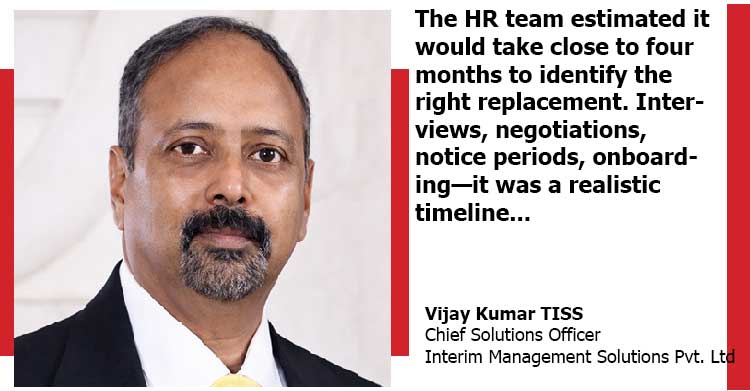
The HR team estimated it would take close to four months to identify the right replacement. Interviews, negotiations, notice periods, onboarding—it was a realistic timeline.
But business wasn’t interested in timelines.
Production targets still had to be met. Customers still expected deliveries. Employees still needed direction. Investors still wanted growth.
The CEO smiled and said something that has stayed with us ever since:
“I don’t have a hiring problem. I have a business continuity problem.”
That single statement perfectly captures why interim management has become one of the most valuable leadership strategies for modern organizations.
The Reality Every Growing Business Faces
Leadership transitions are inevitable.
Separation happen ,People move on. Businesses grow. Companies transform. Markets evolve. Hiring never stands still.
None of these events wait for recruitment to catch up.
Traditionally, businesses viewed executive hiring as the only solution. Find the perfect candidate, complete multiple interview rounds, negotiate the offer, wait through a notice period, and finally welcome the new leader.
It sounds straightforward.
Until you’re the one waiting.
Because while the recruitment process moves forward, business keeps moving too.
Projects don’t pause.
Customers don’t become more patient.
Competitors certainly don’t slow down.
And that’s often where organizations begin losing momentum.
The Hidden Cost of Waiting
Most leadership vacancies don’t immediately appear on a balance sheet.
Instead, the costs show up in quieter ways.
Decisions that once took hours begin taking weeks.
Managers start carrying responsibilities outside their expertise.
Projects lose pace.
Teams become uncertain and Demotivated.
Customers notice slower responses.
The organization keeps functioning—but not performing at its full potential.
These hidden costs are often far greater than businesses realize.
The real question isn’t whether you can afford to hire slowly.
It’s whether you can afford to slow the business while hiring.
Interim Leadership Is About Momentum
One of the biggest misconceptions about interim management is that it’s simply temporary hiring.
It isn’t.
An interim leader isn’t brought in just to occupy a chair.
They’re brought in to solve a challenge.
Whether it’s leading a digital transformation, stabilizing operations after a sudden resignation, preparing a business for investment, integrating two organizations after an acquisition, or guiding a company through rapid growth, interim leaders are expected to deliver from day one.
They don’t arrive asking for months to understand the business.
They arrive asking,
“Where can I create the biggest impact first?”
That mindset makes all the difference
Experience You Can’t Teach
One of the biggest strengths interim professionals bring isn’t simply experience.
It’s perspective. Many have worked across industries, cultures, business models, and economic cycles.
They’ve managed crises.
Led transformations.
Built teams.
Scaled operations.
Improved profitability.
Navigated uncertainty.
Because they’ve solved similar problems before, they recognize patterns quickly.
They know where to ask questions.
They know what usually goes wrong.
And more importantly, they know how to move teams forward without creating unnecessary disruption.
Why Agile Businesses Are Embracing Interim Leaders
The workplace has changed dramatically over the last few years.
Businesses are more connected.
Teams are more distributed.
Technology evolves faster than ever.
Customer expectations shift almost overnight.
In this environment, agility is no longer a competitive advantage.
It’s a business necessity.
An agile organization isn’t one that simply reacts faster.
It’s one that continues making confident decisions, even when circumstances change.
That requires leaders who are comfortable stepping into unfamiliar situations, building trust quickly, and helping teams regain momentum.
Interim leaders are uniquely positioned to do exactly that.
Leadership Is Still About People
One aspect of interim management often gets overlooked.
Its human impact.
Whenever a senior leader leaves unexpectedly, uncertainty spreads quickly.
Employees naturally begin asking questions.
Who’s making decisions?
Will priorities change?
What happens to ongoing projects?
Good interim leaders understand that restoring confidence is just as important as improving performance.
They spend time listening.
Building relationships.
Understanding team dynamics.
Creating clarity.
Because before people follow a strategy, they follow a leader they trust.
A Smarter Way to Think About Talent
Forward-thinking organizations are beginning to view talent differently.
Not every challenge requires another permanent hire.
Sometimes what the business truly needs is specialist expertise for six months.
Sometimes it’s transformation leadership for a year.
Sometimes it’s simply someone who can stabilize the business until the right long-term executive is found.
This flexibility allows organizations to respond faster while reducing risk.
It’s not replacing permanent leadership.
It’s strengthening it.
The Flexy Managers Perspective
At Flexy Managers, we’ve built many success stories by partnering with organizations navigating growth, restructuring, digital transformation, leadership transitions, and operational change.
One lesson has remained consistent across every engagement.
Businesses rarely lose opportunities because talented people don’t exist.
They lose opportunities because timing matters.
The right expertise delivered at the right moment can prevent disruption, inspire confidence, and help organizations continue moving forward when every day counts.
That’s why we believe interim management isn’t simply about filling leadership gaps.
It’s about protecting momentum.
Looking Ahead
The future of work isn’t defined by permanent roles alone.
It’s defined by flexibility.
By access to expertise.
By leaders who can adapt as quickly as businesses need them to.
Organizations that embrace this mindset won’t simply recover faster from change.
They’ll be better prepared to lead through it.
Because when the next unexpected challenge arrives—and it will—the question won’t be,
“How quickly can we hire?”
It will be,
“How quickly can we keep moving?”