



From frugal hack to jugaad innovation: Indian HR change management that works | Dr. Brillian S. K. | Chief People Officer | TimesPro
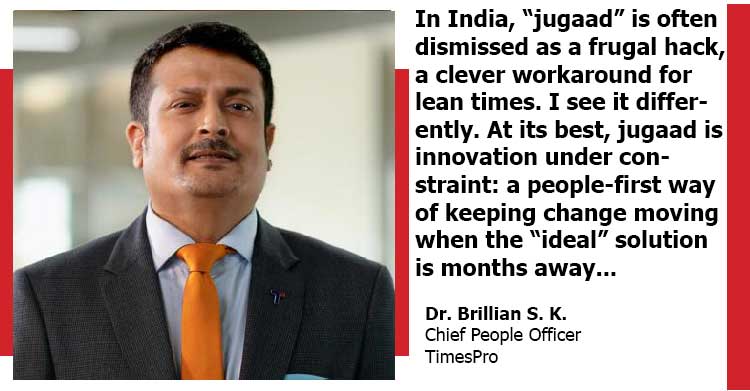 In India, “jugaad” is often dismissed as a frugal hack, a clever workaround for lean times. I see it differently. At its best, jugaad is innovation under constraint: a people-first way of keeping change moving when the “ideal” solution is months away. It is not a licence to bypass governance; it is a bridge that helps you cross a gap, learn quickly and then build something sturdier.
That mindset matters in 2026. Organisations are being pushed to transform at speed, while also absorbing AI, managing hybrid work and protecting trust. PwC’s 2026 Global CEO Survey found that the biggest question on CEOs’ minds is whether they are transforming fast enough to keep pace with technological change, including AI, with 42% naming this as their top concern. Gartner, in a separate study, reported that only 8% of HR leaders believe managers have the skills to use AI effectively. That gap shows up exactly where change succeeds or fails: in everyday decisions, team conversations, and managers’ confidence to guide others.
The simplest place to begin is also the most overlooked: start with people, not the policy. Before you draft the framework, listen. Listen, listen and listen across roles and locations and treat friction as data. Where does the work slowdown? What are managers struggling to explain without sounding uncertain? Then solve with what you have, not with a future solution. One of my former bosses called it “quick and dirty”. He did not mean careless; he meant decisive: move quickly, learn fast and tidy it up once you know what works. A bounded pilot with a short feedback loop and visible sponsorship beats a perfect solution that arrives late.
AI adoption is a great example of why this approach works. Employees are already experimenting, often ahead of formal guidance. Microsoft and LinkedIn’s 2024 Work Trend Index found that 92% of knowledge workers in India use AI at work, and that 54% of leaders worry their organisation lacks a plan and vision for implementation. The risk is not that people will not adopt; the risk is unmanaged adoption. Jugaad innovation here looks like lightweight guardrails and practical routines, a small set of approved use-cases, simple dos and don’ts and a manager clinic to answer awkward questions without judgement. The aim is not to police curiosity, but to protect confidentiality, quality and fairness while learning at pace.
In India, change communication also travels differently. Formal emails have their place, but the office grapevine, WhatsApp groups and informal influencers are often the real distribution network. Treat these channels as assets, not irritants. Bring credible connectors into the story early, share context rather than slogans and invite them to challenge the message in everyday language. When they believe it, talent will listen.
I have seen progress come from coffee conversations and candid leader–employee chats than from even the most polished townhall. The power of such forums is not the format; it is the signal that leaders are willing to listen without defensiveness and that follow-through will be visible.
Recognition is another lever that does not require a budget, only intent. In transition, people need to know their efforts are seen before outcomes are fully visible. Regular R&R, handwritten notes, shout-outs, etc., reinforce what the organisation wants.
To strengthen capability without hierarchy getting in the way, reverse mentoring circles work exceptionally well. They create a dignified exchange where digitally fluent employees share practical workflows, while leaders share context and decision-making. If it’s done consistently, this reduces fear, improves adoption and builds shared language across generations.
Finally, replace long, tiring meetings with short weekly check-ins. Fifteen minutes, done well, is enough to surface blockers early, reset priorities and make small commitments that keep change moving, especially in hybrid teams where misalignment can compound quietly.
None of this works if it becomes a permanent patchwork. Jugaad should be the starting point, not the way you run things forever. It cannot replace good structure and design; it can only help you bridge a short gap. As every organisation is different, avoid blind copying templates. Take ideas, then adapt them to your people, your culture and the way your business operates. Jugaad earns its value when it helps you move fast, without creating confusion and when it leads to better, lasting ways of working.