



Building the Foundation Early-Career Learning as a Retention Lever in Insurance | Sunder Natarajan | CHRO | IndiaFirst Life
In the high-stakes world of insurance sales, early-career learning and structured development are critical to building a resilient and high-performing team. Much like a well-assembled cricket squad, where each player from dependable openers to dynamic middle-order batsmen contributes uniquely to the team’s success, the insurance industry thrives when its salesforce receives the right training and guidance at every stage of their journey. This article draws a parallel between cricket and insurance, using the familiar roles and strategies of a cricket team to illustrate how a thoughtfully crafted learning roadmap can empower insurance salespersons to achieve sustained success and drive organisational growth. Join us as we explore the synergies between these two fields and uncover the secrets to nurturing winning teams, both on the pitch and within the insurance sector.
Our Imaginary Insurance Cricket Team
Cricket Team Insurance Company
Dependable Openers Seasoned Frontline Sales & Senior Agents
(Reliable, Systematic, consistent income, low turnover)
Key Middle Order Newly recruited salespersons & new agents
(Pressure of early wins, higher turnover)
The Head Coach/Manager The Company Leadership / Sales Manager
Structured Approach Initial Product & Process Training , Compliance
Special Mentorship
Specialised Training Camps/ Career Learning Frameworks
Batting Data Analyst AI based hyper personalised training
“The Insurance XI,” had star openers who consistently delivered big scores and had been with the team for long. They were having long-standing client relationships and seasoned players who benefited with handsome incentives, rewards & recognition.
The challenges lay in the middle order. They were young, energetic, and recruited in large batches, but were the most volatile part of the team.
High Churn: Every time the team toured a new country (i.e., a new sales quarter), two or three middle-order players would quit because they felt overwhelmed by the pressure, inconsistent performance, and the limited scope of their role (just trying not to get out).
The Cost: The Head Coach (Management) had to constantly scout, recruit, and spend weeks teaching the new players the basics of the “Net Practice” (Product Training), which was expensive and draining. The coach knew the
team could not win tournaments if the middle order kept collapsing.
The Historical Approach: Keep the scoreboard ticking
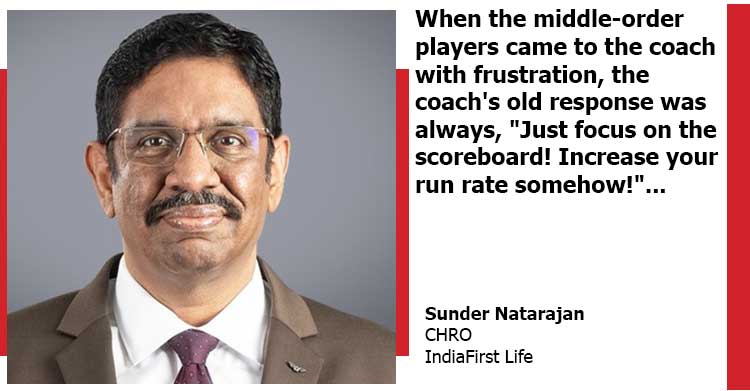
When the middle-order players came to the coach with frustration, the coach’s old response was always, “Just focus on the scoreboard! Increase your run rate somehow!”
This focus on the doing business somehow (the score), without focusing on the skills (the technique), failed as a retention strategy. The players felt they were just temporary gap-fillers. They were leaving for other teams that promised “better infrastructure” (i.e., more defined career paths).
The New Strategy: Building the Foundation Early
The Head Coach realised that the only way to keep the middle order was to show them a clear, challenging, and valuable future within the team. They created Specialised Training Camps (The Career Learning Framework).
1. The Structured Approach
Instead of just telling the players to “score,” the coach showed them a clear path:
Basic Net Practice: Master defensive technique and rotate the strike (Prospecting, Lead generation & selling simple products).
The ‘Finisher’ Training: Master the “death overs” hitting (Advanced Closing
Techniques for Complex Policies like Employer Employee or MWPA). To pass this, a player had to complete a specialised two-week camp on financial planning, customised insurance solutions and negotiation, earning a Micro-
Credential as a “Death-Over Specialist.”
Vice-Captaincy Track: Complete a course in field setting and motivating teammates (Agency Management & Team Leadership).
2. Special Mentorship
The coach didn’t just lecture; he mandated deep interaction between the top and bottom of the talent pool:
Openers Mentoring the Middle Order: Seasoned frontline openers were given Rewards & Recognition to mentor one middle-order player each, focusing not just on technique, but on the mental game and how to handle pressure (Soft Skills and Client Relationship Management). This Mentorship made the young players feel like they had a direct line to the most valuable institutional knowledge.
3. AI-Driven Remediation (The Batting Data Analyst)
The team brought in a Batting Data Analyst (AI). Every time a middle-order batsman got out, the analyst would at once tell them why based on the data: “Player 5, you have a weakness against leg-spin on a turning pitch. Your bat-swing is too wide.”
The analyst didn’t just point out the weakness; they at once recommended the precise, short-video drills (training modules) to fix the flaw. This personalised, data-driven coaching proved that the team was investing in the player’s specific, high-value skill set, not just yelling at them to score faster.
The Result
The middle-order players stopped seeing their role as a temporary, pressure-cooker assignment. They saw it as a defined series of skill-building levels leading to a high-earning, leadership role.
By investing in specialised skills, granting immediate recognition for mastery (Micro-Credentials), and providing clear visibility of the career trajectory to captaincy (Agency Management), the team successfully transformed basic training into a powerful retention lever. The Middle Order stabilised, the churn stopped, and the Insurance XI began winning tournaments with a deep, confident lineup.
Disclaimer: This is an imaginary story aimed at depicting possible scenarios which exist in the industry and the opportunities that exist. It does not depict any individual company.