

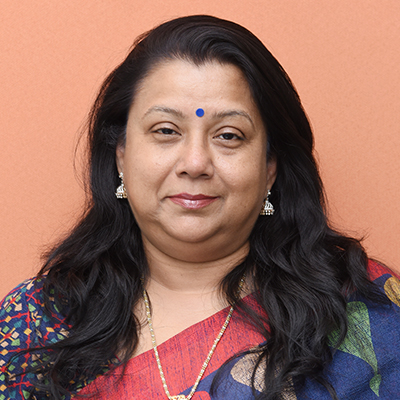
An interview with Poonam Chandok | VP & HR Head | L&T Energy Hydrocarbon
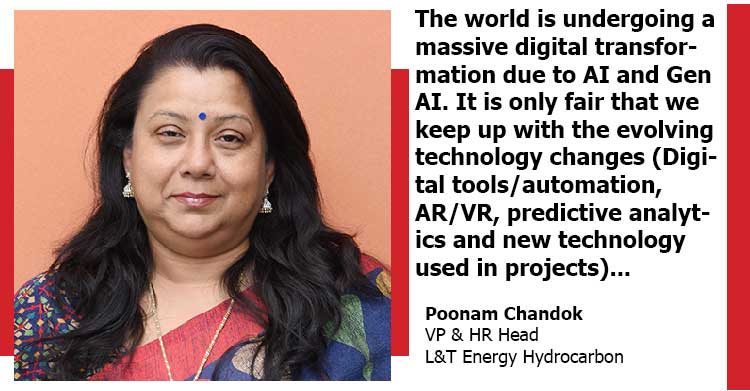
In an exclusive interview with The People Management magazine, Poonam Chandok, VP & HR Head, L&T Energy Hydrocarbon, discussed the challenge of fostering a unified, multigenerational culture while upholding the discipline, governance, safety compliance, and operational rigor that define LTEH.
What are the key challenges for HR in Managing Multi-Generational Workforce
Here are the key challenges HR must address in detail:
I. Conflicting Expectations of Work Culture & Leadership across generations
The key challenge is the clashing generational value systems with the traditional and hierarchical nature of the EPC business.
Generational Value Differences:
o Boomers value stability, hierarchy, and loyalty.
o Gen X prefers autonomy and productivity.
o Millennials seek purpose, continuous feedback, and clear growth pathways.
o Gen Z looks for flexibility, empowerment, and rapid learning.
The challenge here is in designing a unified culture that appeals to all generations while maintaining the discipline, governance, safety compliance, and operational rigor that L&T Energy Hydrocarbon (LTEH) is known for.
Being inclusive of the various generations will have to be a Top-down approach and requires training leaders to shift from a purely command and control style to one that is emotionally intelligent, inclusive, agile and empowering. This has been done through various approaches at LTEH:
1. Technology Adoption & Digital Transformation
We are currently in a scenario, where the world is undergoing a massive digital transformation due to AI and Gen AI. It is only fair that we keep up with the evolving technology changes (Digital tools/automation, AR/VR, predictive analytics and new technology used in projects). This may lead to a generational divide in capability and acceptance.
The Younger employees are digital citizens and adapt. Senior employees, who often hold the deepest technical and institutional knowledge, may resist or struggle with newer digital platforms or tools.
Driving rapid digital adoption across the organization without alienating senior talent, involves balancing the push for tech efficiency with human acceptance. At LTEH, we have creating task forces across generations to blend strategy with technological innovation in all our projects. This is not just a mechanism to adopt new age technology, but also helps us to optimise cost.
2. Learning & Development (L&D)
In an EPC business, skill is non-negotiable, yet generational learning styles are vastly different across:
o Boomers prefer Classroom, instructor-led training sessions
o Gen X prefer Self-paced & structured learning
o Millennials favour Collaborative, blended learning modules
o Gen Z prefer small bite-sized, technology-first, and gamified or simulation content.
HR must deliver customized, multi-modal learning ecosystems while ensuring that non-negotiable technical and safety training remains standardized, compliant, and equally effective for all learners.
We have introduced various byte sized simulation modules with ‘FLOGAMES’ and tied up with ‘Skillsoft Percipio’ to launch e-learning courses. Additionally, we also offer Coursera licenses to all employees for self-paced learning journeys. A blended learning approach is used for training of experienced professionals which is more hands on and experiential in nature. We have another platform RAPL which supports us in running quizzes for knowledge testing purposes.
In the month of November, each year we design a gamified initiative – Learnfest to propagate the benefits of e-learning and have a focused approach towards upskilling themselves which supports in building a culture of learning throughout the organisation. Driving this throughout the month helps us build focus on building the learning culture as well as to ensure that trainings are reaching to the last mile employee on project sites or at offshore.
Inclusivity in learning goes beyond generations, at LTEH we have a training journey called Coach Vani, the objective of which is to enhance their English-speaking ability. A large part of our workforce belongs to tier 2 or 3 cities of India and few rural regions, it is imperative that we support them in dialectal inclusion. Since English is a commonly used business language, training them in that helps them articulate their thoughts better and builds confidence while dealing with clients from other countries.
3. Career Progression
Across generations they fundamentally different timelines and metrics through which they measure their career success or career pathing Expectations:
o Boomers/ Gen X would expect tenure-based progression as they value loyalty towards the organisation that they are contributing towards
o Millennials and Gen Z would expect quicker, transparent, merit or performance-based growth. Younger employees become increasingly disengaged if career trajectories seem slow.
The challenge for the Talent Management team of HR is to reimagine career paths and succession planning in a project based and inherently hierarchical organization.
At LTEH, we utilise multiple strategies to engage our employees and provide a career path.
We utilise Internal Job Postings – (IJP’s) which are one way to keep the younger workforce more engaged by getting them the opportunity to navigate across roles and develop themselves as a leader in a holistic manner.
To identify high potential employees early on we have introduced the Most Promising Trainee award for the GET’s & PGET’s in their first year. They undergo multiple training programs and job rotations basis which they will be creating and submitting project-based presentations to the senior leaders. Identifying Hi-Po employees early on helps the organisation in grooming them to take up managerial roles early on.
Additionally, Hi-Po employees undergo a DC (development centre) process, this process is a simulation-based testing technique that measures the key competencies identified for the employees. They receive a score on the competencies identified based on which they get an opportunity for trainings. The DC scores also support in fast tracking promotions within the organisation.
4. Communication & Feedback
There are different styles and expectations of how communication and performance feedback should be delivered across the generations.
Senior employees i.e. Boomers or GenX prefer formal, documented, and periodic (annual/semi-annual) communication or feedback. They may be a little resilient to seek feedback or make the necessary changes required.
Younger employees expect instant, candid, and continuous feedback for their tasks which may not always be possible.
The challenge here is to train leaders to be inclusive, using multi-modal communication to bridge this gap. We initiated trainings called Conversations That Count which trained 1000+ managers in the art of giving and receiving feedback. This includes enlightening them about the importance of annual appraisal process, why it is essential to set continuous performance conversations that complement, rather than replace, formal annual discussions, ensuring all generations feel heard and directed. It builds in a culture of open and transparent communication.
Youngsters also prefer to be recognised and appreciated for the work that they do which acts as a positive reinforcement – our hi5 online recognition platform allows managers and senior team members to share digital on the spot certificates and badges to the youngsters which helps make positive reinforcement a part of the culture.
5. Inclusion & Psychological Safety
A multi-generational workforce impacts foundational elements like team dynamics and team collaboration. Varying opinions and perceptions may lead to team conflict of feeling of not being understood.
Major impact areas for the team – Psychological safety, collaboration, interpersonal trust, and conflict resolution may feel strained in case different generations don’t feel respected.
To create an environment where every generation’s voice is respected and valued, requires targeted interventions or initiatives to build inter-generational trust and ensure that voicing an opinion contradictory to a senior’s idea (by a junior employee) is seen as innovation, not insubordination. We ran multiple focus grouped discussions to understand the key themes or points on which disagreements or conflicts arise. Feedback from these discussions was used to customise sensitization sessions across LTEH targeting leaders and all employees. These sessions consisted of identifying biases and myths that we may be holding onto about different genders or generations and breaking them. The session used theatre-based role-playing approach to help them enact and understand the biases at a deeper level as well help resolve them as participants. Most feedback received from these sessions showcased that they could relate to or had similar experiences during their corporate life.
II. What are other ways that a company can utilize a multigenerational team to their advantage
DEI as a moment has been extremely prominent amongst corporates, the best organizations don’t just tolerate differences; they actively engineer collaboration to maximize business outcomes, particularly in areas like innovation, customer reach, and risk management. This diversity can be in terms of gender, generation language, region or caste.
1. Enhancing Innovation and Problem-Solving mindset
Various studies have shown that diversity is one of the most effective ways to combat groupthink or what we call herd mentality. Generational diversity specifically supports in bringing various perspectives to arrive at more robust solutions.
• Blending Innovation with Risk Aversion:
o Senior Generations (Boomers/Gen X): Provide the historical context, risk assessment, and tried & tested methodologies which are crucial for the projects stability and in preventing past mistakes (e.g., assessing engineering feasibility based on decades of site experience).
o Younger Generations (Millennials/Gen Z): Bring in innovation/disruption in terms of operational excellence, digitisation and process or SOP improvements, agility, and fresh perspectives (e.g., proposing an AI-driven predictive maintenance solution or a novel strategy).
HR can look at deliberately forming cross-generational task forces for major challenges (e.g., bidding for a new type of contract). This ensures that innovation is both cutting-edge and practically viable, avoiding stagnation and reckless modernisation without proper risk assessment. Failures in EPC projects lead to major cost impact, therefore the risk assessment done must be through along with cost optimisation strategy.
In one of our businesses, we introduced a Multi-Rater Feedback mechanism that enabled employees to share feedback for any colleague within the business irrespective of their designation. This was revolutionary for a hierarchy-oriented EPC organisation like ours. The process was conducted in a fully anonymous and unbiased manner, and each employee received a comprehensive one-page report summarising key strengths and areas for improvement, thereby facilitating meaningful self-reflection and personal development.
This intervention helped foster a culture of transparent and constructive feedback. It led the leaders to acknowledge the expectations of the younger workforce, who value openness and continuous growth. As all employees received feedback through this process, it strengthened a sense of inclusivity and supported a holistic, 360-degree approach to individual assessment and development.
2. Building Resilience and Agility at LTEH
A company can withstand many challenges with high adaptability becoming resilient to market shifts, technological changes, and operational disruptions.
• Business Continuity: A term popularised during covid but stands true at every stage, as irrespective of the internal or external business challenges, rotation of workforce or any other factor the business must not get affected. This can be ensured through Knowledge Transfer and Retention programs. One of our internal institutes – IPM has launched a book on capturing the various case studies or learnings from different projects. We additionally curated an in-house knowledge management portal – DHRISHTI, which allows employees to upload and share documents and learnings from other projects or past projects. It ensures that key institutional details related to marquee projects are captured before leaders retire or employees leave. This supports in stabilizing the technical and operational base which can support younger leaders or project directors when they are executing projects and are obstructed by a similar challenge.
• Adaptability: Younger generations, having grown up in periods of rapid technological change and economic volatility, naturally possess high adaptability. They prefer to learn new things and upskill themselves frequently. They adapt to different project conditions, challenges and deadlines along with the volatility of the situation. This can be advantageous to organizations as the younger generation can be used as the pioneers of change and innovation within the system.
3. Building Inclusive Leadership
The multi-generational diversity drives the organizations to obtain better, more inclusive leaders.
Coaching styles: Leaders will have to be trained to recognize that ‘leading’ a Boomer who values stability is different from ‘coaching’ a Millennial who seeks growth, or ’empowering’ a Gen Z employee who wants autonomy.
This need for customisation in managing a generationally diverse team, pushes HR especially L&OD professionals to implement inclusive leadership training that focuses on situational leadership and emotional intelligence. Leaders must tailor their communication style and motivation strategies, making them connect across all employee demographics, ultimately leading to enhanced engagement and reduction in retention risk.
Building a mindset of inclusive leadership does not happen with one training or a few coaching sessions, it is a journey that needs to be imbibed within the organisation that will eventually become a system. Few years back, we embarked on one such OD journey where through employee feedback we at LTEH developed a culture credo or framework – ENERGY.
Each word of this framework is an acronym for a tenet, values that all employees need to imbibe within themselves to be truly inclusive and efficient. The tenets are – Entrepreneurial Excellence, Nurturing Openness and Boldness, Effective Empowerment, Rally together for Performance, Productivity & Safety, Growing Talent & Youthful ENERGY. All these together focus on inculcating a culture of accepting diverse age groups, thoughts, genders and other differences. It focuses on building an environment that is all-encompassing. Multiple initiatives and sessions have been driven around the culture credo to help the employees role model these behaviours. Few snippets of these:
• Unveiling the framework by the DMD across the organization via townhall, project meet and other interactive forums.
• Creating a behavioural Menu card of Do’s & Don’t’s to define the behaviours under each tenet. This will help them understand the true essence of that tenet.
• Induction sessions on ENERGY using stories from within the organisation that inspire role modelling or positive reinforcement of these behaviours.
• Project/site level interventions in line with linking ENERGY to project success matrices and team effectiveness outputs by creating task forces within the project teams.
• ENERGY Exemplars Award – an award category that was introduced to recognise the leaders or managers who are living these behaviours and living the talk for their teams.
All these initiatives helped us build a culture which supports us in becoming a Great Place to Work.
III. What is your recommendation in managing a multigenerational workforce better?
Psychological Safety – True inclusion happens when you provide the employees with a psychologically safe place to work. This includes the person feeling safe to share their ideas, thoughts & beliefs without fear of judgement or repercussions. Youngsters prefer to share their ideas and opinions more strongly and openly as compared to the previous generations, when provided with the psychological safety and guidance, this can support them in growing themselves and being refined corporate professionals. While the younger generation needs to moderate the direct style of communication used, the older generation should learn to have an open mind, instead of dismissing the younger generation. The ENERGY framework that we have created as the culture credo, plays a major role in supporting the acceptance and creation of this environment.
Re-Imagine Career Pathways – The younger workforce is more agile and therefore also more driven when it comes to success in the corporate. They are impatient and hungry for growth; balancing is a delicate rope HR must walk on. HR can look at creating Project-Based cross generational teams, the focus is on having horizontal career movements. Allowing them to move sideways into different functions (e.g., from Design to Procurement) to gain faster, holistic experience without waiting years for a vertical promotion. The seniors can act as guides or Subject matter experts to create e successors and step out of leadership roles and act as advisors. In this way the project risk is minimised and there are no blockers for the younger lot.
IV There are four generations in the organization – baby boomers, Generation X, millennials and Generation Z in today’s workplace. What is your advice to each generation?
Advice to Baby Boomers
1. Become the Mentor: Baby Boomers are the oldest generation who have run this institution, their knowledge is the organization’s most powerful asset, but it holds no value if it retires with them. Proactively work towards identifying successors, instead of feeling insecure. You need not view sharing your secrets/knowledge as a loss of power, but as cementing your legacy.
2. Lead with Purpose: You grew up at a time where questioning adults was a taboo, you are used to command-and-control. The younger generation today, will only follow you if you explain the WHY behind the instruction. Simon Sinek’s – ‘Start with WHY’ is a powerful book that exemplifies the importance of leadership drive via purpose and that starts by answering WHY. Shift your communication from “Do it because I said so” to “Do it this way because, in 1998, we tried X and safety was compromised.”
3. Technology upgradation: You don’t need to code, but you must be digitally savvy. Ask a Gen Z employee to show you the shortcuts or engage in reverse mentoring. They will love teaching you, and it bridges the divide instantly.
Advice to Generation X
1. Be the change: You are currently the generation, “sandwiched” in management. Your job is to translate the mission from the Boomers into meaning for the younger groups. The generation before you may not be able to adapt beyond a given point, therefore the onus of holding the hierarchy together and becoming the glue is on you.
2. Effective Empowerment: One of the pillars in our ENERGY framework, it talks about shared responsibility of the task and empowering your teams to effectively carry out the task delegated to them. You as a generation value autonomy (“Just let me do it”), but to scale yourself, you must trust Millennials and Gen Z to carry out the task instead. Invest time in training the youngsters so you can step up to formulating strategies at an organisational level.
3. Work-Life Integration: For a very long time we have struggled with Work-Life Balance but they both are essential and major parts of our lives and therefore need to be integrated rather than balanced. Gen X is one of the hardest working generations, prone to burnout. You need to be a role model and show the younger generation that it is possible to be a senior leader and have a life outside of work.
Advice to Millennials
1. Being Patient: As an oil & gas industry, the EPC projects take years, not weeks. Do not mistake “slow progress” for “stagnation.” Learn the complexities of a large-scale engineering project. Learn to be patient as endurance is what separates a manager from a leader.
2. Stepping into Managerial roles: Most millennials are now stepping into managerial or first-time manager roles. While You seek feedback for your work and tasks, you now need to step into senior roles. Instead of expecting constant direction, feedback and reinforcement you must now become comfortable making tough calls without validation.
3. Managing upwards: While you may relate a bit more with Gen Z rather than the older generations, upward management is required. You may prefer to call the shots and like a flat structure with complete empowerment, however, in a high-risk industry, hierarchy exists for safety and compliance.
Advice to Generation Z
1. Flexibility is industry specific: As a generation you give great value to flexibility, and that is valid. But in our industry, osmosis is real. Being physically present at a project site or yard allows you to overhear how a senior handles a crisis call or how a procurement deal is negotiated. You can’t learn “soft influence” over Zoom.
2. Human Connect is the key: Your generation thrives on digital media and prefer that employees respond over mails or teams. While text and chat are efficient, but they lack nuance. When a conflict arises, or a complex problem needs solving, pick up the phone or walk to the desk. This supports in building relationships and network within the ecosystem which will help not only your career growth but also can be leverage in times of need or challenges faced.
3. Become Resilient – Gen Z and beyond as a generation has got it all from their parents and caregivers, as they enter the corporate, they need to become more resilient. In the workplace they must deal with multiple rejections, challenges, harsh working environments. You must build focusing on building resilience and imbibe the strategy of ‘Fail Fast, Learn Fast’ to combat any challenges that they face.
As an organization, LTEH is a beautiful amalgamation of all the generations working together to create some of the most challenging and toughest EPC projects. While we all have our differences, we all try to bridge them and work together towards our common goal. For us the motto is – ‘Together We Succeed’ i.e. we are stronger, shaper and smarter together!