

Employee Relations as a Strategic Enabler of Productivity and Growth | Santosh Deshpande | GM – HR | Schneider Electric
 Harmonious employee relations are no longer a matter of good practice alone — they are a business imperative. Across industries, the quality of the relationship between employers and their workforce directly shapes productivity, operational stability, and long-term growth. This article draws on recent developments in India, emerging data, and structural workforce changes to present a clear and grounded perspective on why employee relations must be treated as a strategic priority.
1. WHAT WE ARE SEEING ON THE GROUND
India’s industrial landscape in 2026 has offered a vivid reminder of what happens when employee relations are under strain. Industrial hubs such as Noida, Manesar, and Gurugram have witnessed labour unrest triggered by wage stagnation, rising living costs, and gaps in working conditions. These situations have disrupted production cycles and impacted supply chain efficiency across multiple units simultaneously.
What is particularly noteworthy is that employee relations challenges are no longer confined to the shopfloor. The aviation sector has also seen disruption — operational issues linked to pilot rostering and duty scheduling led to flight cancellations and delays, affecting both business continuity and customer experience. These examples make an important point: employee relations touch every sector — manufacturing, services, aviation, IT, and the growing gig economy.
“When employee relations are under stress, it shows — in absenteeism, in delays, in the quality of output, and eventually, in the bottom line.”
2. THE WAGE–INFLATION GAP: A KEY PRESSURE POINT
One of the important, and sometimes under-recognised, aspects influencing employee relations is the widening gap between wages and the cost of living. Between 2021 and 2026, India’s Consumer Price Index for Industrial Workers (CPI-IW) increased by approximately 24.8%, while wage revisions in several states have progressed at a relatively more measured pace.
Over time, such gaps can shape employee perceptions around fairness in reward structures. Where employees begin to feel that compensation is not fully aligned with evolving cost realities, it may gradually influence levels of engagement, attendance patterns, and overall sentiment on the shop floor. In some situations, this can also contribute to collective expressions of concern.The data below captures this dynamic:
Stress Factor Impact on Employee Relations
___________________________________________________________
Wage stagnation Sense of perceived inequity
___________________________________________________________
Rising cost of living Increased dissatisfaction and unrest
___________________________________________________________
Delays in revision Erosion of trust between employer and workforce
____________________________________________________________
Table 1: ER Stress Indicators — Wage and Inflation Dynamics
3. EMPLOYEE RELATIONS AS A PRODUCTIVITY ENABLER
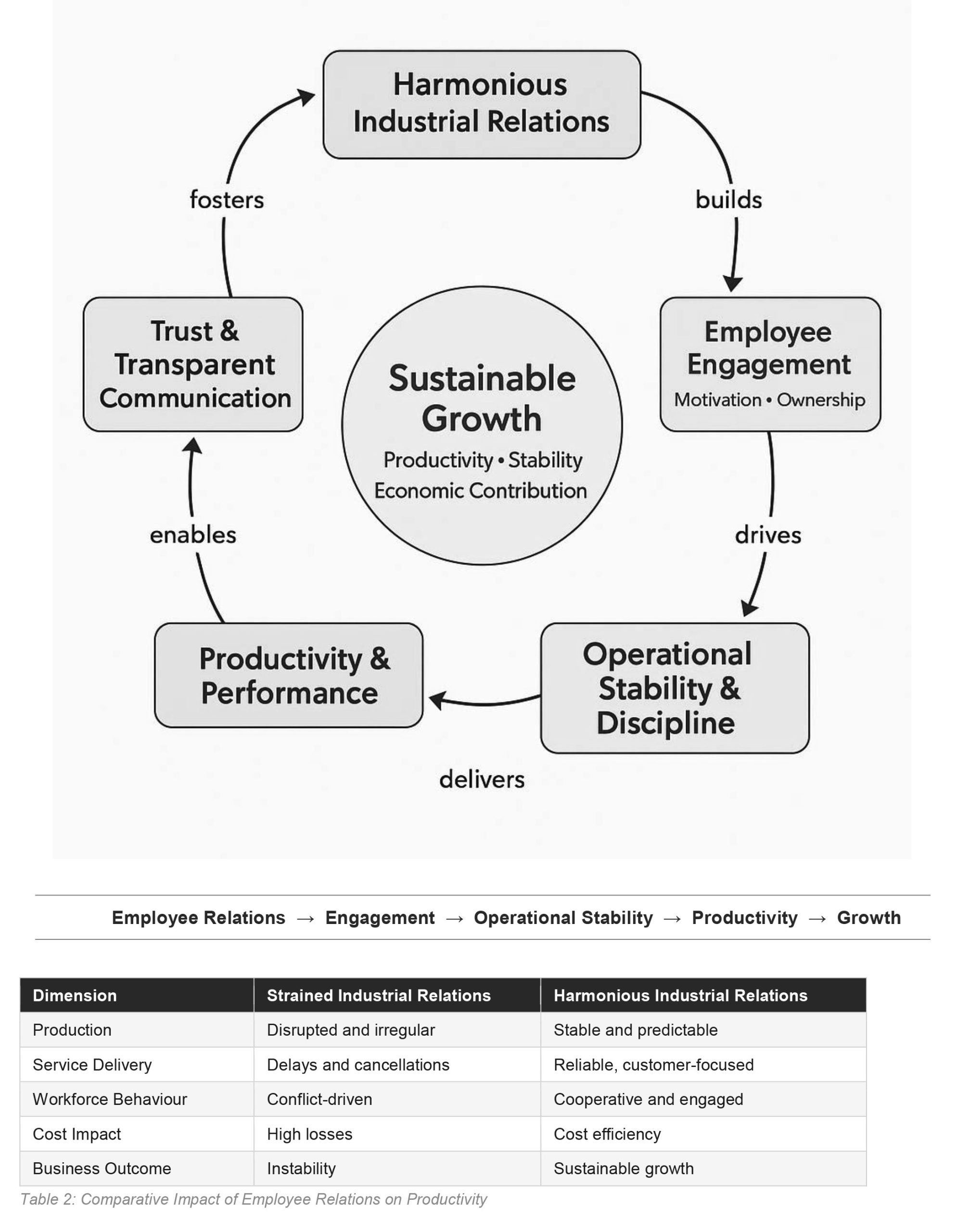
At its core, employee relations encompasses communication, trust, fairness in wages and working conditions, employee participation in decision-making, and compliance with statutory frameworks. When these elements are in place, the impact on productivity is measurable and significant.
Research consistently shows that positive employee relations improve engagement and reduce operational friction. The linkage is straightforward: