


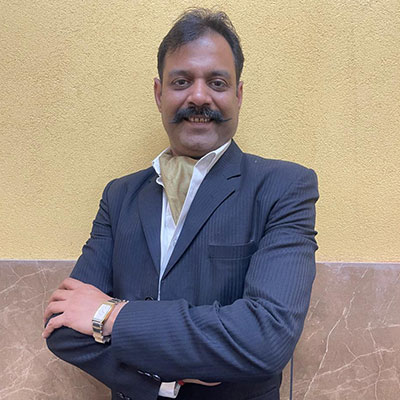
How NGOs and Corporates can work together for Long-term change? | Prerrit Mansingh | Secretary | Aayom Welfare Society
 Over the last decade, India has witnessed a remarkable rise in corporate social responsibility (CSR). Since it became a mandate under the Companies Act, CSR spending has grown exponentially crossing ₹2.17 lakh crore between 2014 and 2024, with annual spending touching nearly ₹30,000 crore in recent years.
This scale of investment signals intent. But intent alone does not create impact. The real question is, has this capital reached the people who need it the most?
The answer is: not fully.
Despite this massive growth, the distribution of CSR funds remains uneven. A significant portion of funding is concentrated in a few developed states, while underserved and aspirational districts receive only a small share. And the reason – CSR companies want to spend where they exist and not where the real need is. In fact, only about 12% of CSR spending has reached these high-need regions in recent years.
This gap is not just geographical, it is structural. And this is where our role as NGOs become indispensable. We work closely with communities where the real needs are often unseen. We understand the realities behind statistics, the lived experiences of communities, the cultural nuances, and the actual barriers people face. We know that before talking about innovation, entrepreneurship, or large-scale transformation, communities need access to
basics: education, healthcare, skills, and livelihood opportunities.
Corporates, through CSR, bring the ability to fund, scale, and systemize these interventions. But without grassroots insight, even well-funded programs become misaligned with real needs. This is why collaboration is not optional but it is essential.
When NGOs and corporates work together, we bridge the gap between resources and relevance. NGOs define the “what” and “why” based on ground realities, while corporates enable the “how” and “how far” through capital and scale. This alignment ensures that impact is not only visible, but meaningful.
And yet, despite the opportunity, several gaps still exist in this partnership. A large number of NGOs, especially smaller ones, still struggle to access CSR funding. Studies show that while most NGOs are eligible, not every eligible NGO actually receive CSR support, often due to limited capacity in documentation, reporting, corporate
engagement and popularity of the NGO.
At the same time, corporates are increasingly moving toward direct implementation, reducing their reliance on NGOs. While this improves control and measurement, it risks disconnecting programs from grassroots realities, where NGOs bring the most value.
So, what is missing?
First, there is a need for stronger alignment. CSR cannot function as a compliance-driven activity. It must be treated as a long-term investment in social ecosystems, where NGOs are strategic partners, NOT JUST IMPLEMENTERS.
Second, capacity building within NGOs is critical. Nearly 80% of NGOs report a lack of corporate networking opportunities and support systems. Bridging this gap requires investment not just in projects, but in strengthening the organizations that deliver them.
Third, there is a need for better distribution of resources. If 70% of CSR funds continue to flow into a handful of states, the vision of inclusive growth remains incomplete.
Collaborations must consciously prioritize underserved regions.
Fourth, trust and transparency must evolve on both sides. Corporates seek measurable impact, while NGOs need flexibility to respond to on-ground realities. Technology, data-driven reporting, and open communication can help bridge this divide.
We at Aayom Welfare Society demonstrate how this balance can be achieved, by combining grassroots understanding with structured corporate partnerships to build programs that focus on long-term empowerment rather than short-term outputs.
Ultimately, the future of social impact lies not in how much is spent, but in how effectively it is used. Before we aim for large-scale revolutions, we must ensure that the fundamentals are in place.
And when NGOs and corporates come together with shared intent, aligned vision, and mutual respect, they don’t just fill gaps, they create pathways. Pathways that lead not only to development, but to dignity, independence, and lasting change.