



Why Reimagining Talent in a Skills-Driven World Is an Immediate Strategic Necessity | Satyen J. Mamtora | CEO & MD | Transformers and Rectifiers India (TARIL)
India’s power and infrastructure sector is entering a phase of unprecedented expansion, driven by rapid grid modernisation, renewable energy integration, and rising industrial demand. The scale of this transformation is significant, India is targeting 500 GW of non-fossil fuel capacity by 2030, alongside substantial investments in transmission and distribution infrastructure. However, as projects grow in size and complexity, a critical constraint is emerging. It is not capital or demand, but the availability of a workforce equipped with the right combination of engineering, digital, and execution capabilities.
The Changing Nature of Work in Power and Manufacturing
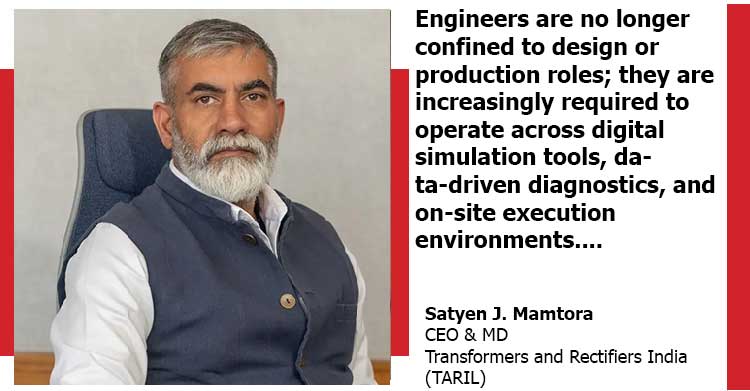
In transformer manufacturing and large-scale electrical infrastructure projects, the nature of work has fundamentally evolved. Engineers are no longer confined to design or production roles; they are increasingly required to operate across digital simulation tools, data-driven diagnostics, and on-site execution environments. At the same time, maintenance functions are shifting from reactive approaches to predictive, technology-enabled systems. Despite this shift, many organizations continue to rely on workforce models built around fixed roles and hierarchical structures, creating a disconnect between the demands of the business and the capabilities of the workforce.
From Talent Management to Business Imperative
Reimagining talent, therefore, is not an HR-led initiative, it is a business imperative. At its core, it requires a shift from hiring for static roles to building adaptable capabilities that can respond to evolving project requirements, technological advancements, and execution challenges.
From Role-Based Hiring to Capability-Based Deployment
The first and most immediate shift is from role-based hiring to capability-based deployment. In infrastructure-led sectors, project requirements change far more rapidly than job descriptions. Engineers and technicians must be equipped to move across functions, design, manufacturing, testing, and commissioning, depending on project needs. This requires building multi-skilled talent pools rather than narrowly defined roles, enabling organizations to respond more effectively to execution demands.
From Workforce Planning to Skills Intelligence
Equally critical is the move from static workforce planning to skills intelligence. Many organizations lack a real-time understanding of their internal capabilities, making it difficult to align talent with project pipelines. In an environment where delivery timelines are tightening and project complexity is increasing, companies need to map existing skills, identify gaps linked to upcoming projects, and anticipate future capability requirements. Organizations that have begun adopting data-driven workforce planning are already seeing improvements in productivity, reduced project delays, and better resource utilization.
From Training to Continuous, Embedded Learning
Another important shift is from periodic training to continuous, embedded learning. Traditional training models, often conducted in isolation from actual work, are no longer sufficient in a fast-evolving industry. In sectors such as power and infrastructure, capability building must be integrated into daily operations. Engineers and technicians must continuously upgrade their skills through real project exposure, on-site problem-solving, and the use of digital tools. This approach not only accelerates learning but also ensures immediate application, improving both efficiency and outcomes.
From External Hiring to Internal Mobility
Organizations must move from an over-reliance on external hiring to unlocking internal mobility. The talent required to meet evolving demands often already exists within the organization but remains underutilized due to rigid role definitions. By enabling cross-functional movement and project-based deployment, companies can improve resource utilization while also enhancing employee engagement and retention. In an environment where industry-ready talent is scarce, internal mobility becomes a strategic lever rather than a secondary initiative.
Why the Shift is Urgent Now
The urgency of these shifts is reinforced by broader structural changes in the industry. The integration of renewable energy is increasing the complexity of grid systems, requiring more sophisticated engineering and operational capabilities. Automation and digital technologies are transforming manufacturing processes, while global quality benchmarks are becoming more stringent. At the same time, workforce studies indicate that a majority of employees are already using digital tools in their daily work, and both employees and employers recognize continuous skill development as critical to performance. This highlights a clear gap between the pace of industry transformation and the readiness of existing workforce models.
Talent as a Driver of Execution and Competitiveness
For India’s power and infrastructure sector, the implications are clear. The ability to deliver large-scale projects on time, integrate renewable energy efficiently, and compete in global markets will increasingly depend on how effectively organizations can build and deploy skills. Talent is no longer a support function, it is central to execution, efficiency, and long-term competitiveness.
Conclusion- From Workforce Strategy to Growth Enabler
Organizations that continue to rely on traditional, role-based workforce models risk facing execution delays, rising costs, and missed opportunities. In contrast, those that adopt a skills-first approach by building multi-skilled talent, leveraging skills intelligence, embedding continuous learning, and enabling internal mobility, will be better positioned to navigate complexity and scale effectively. In a sector defined by precision, timelines, and scale, the shift from jobs to skills is not just a workforce transformation. It is fundamental to how organizations will deliver the next phase of India’s infrastructure and energy growth.